EatQuik explores a more considered way to connect surplus food with people nearby — through mystery bags, clearer collection journeys and AI-assisted discovery. This is a proposed product experience, not an operating marketplace.
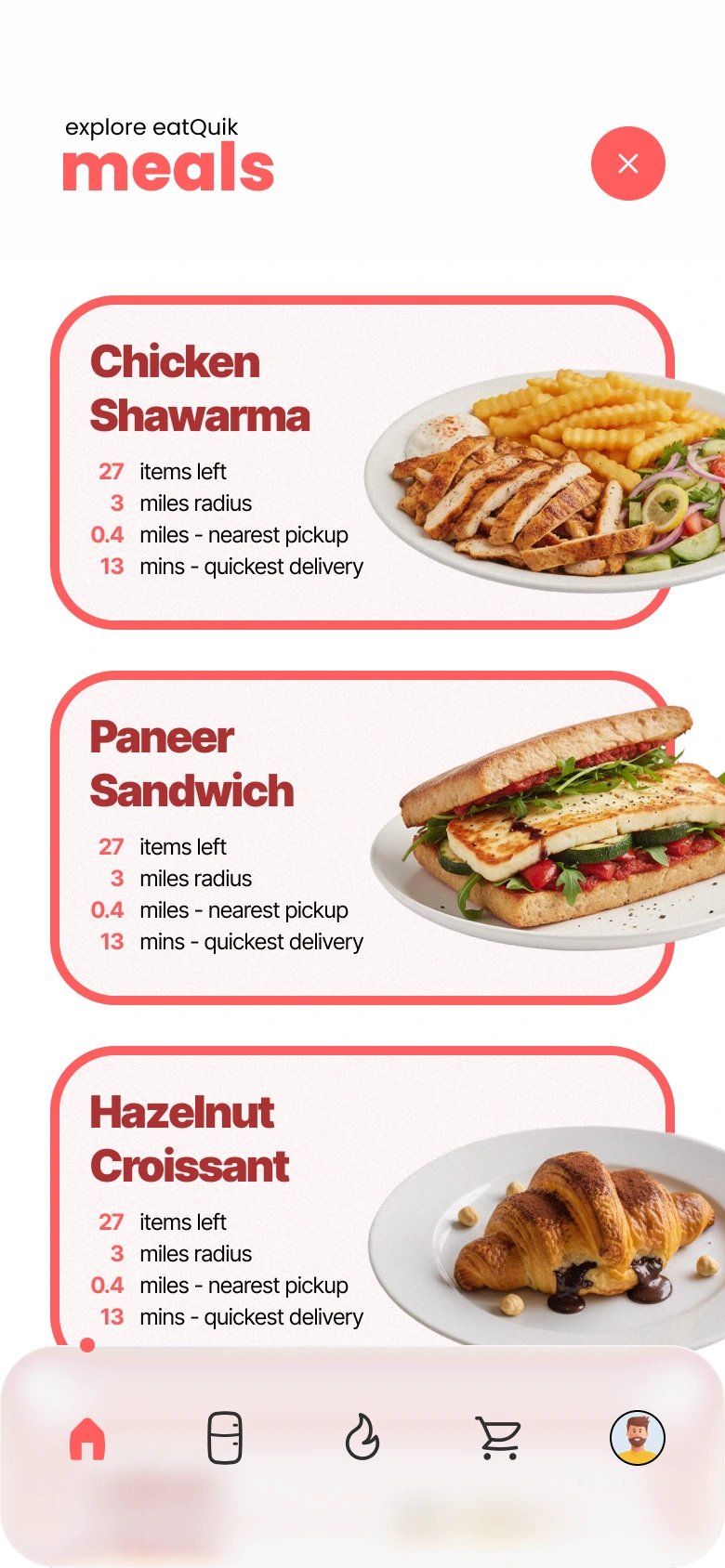
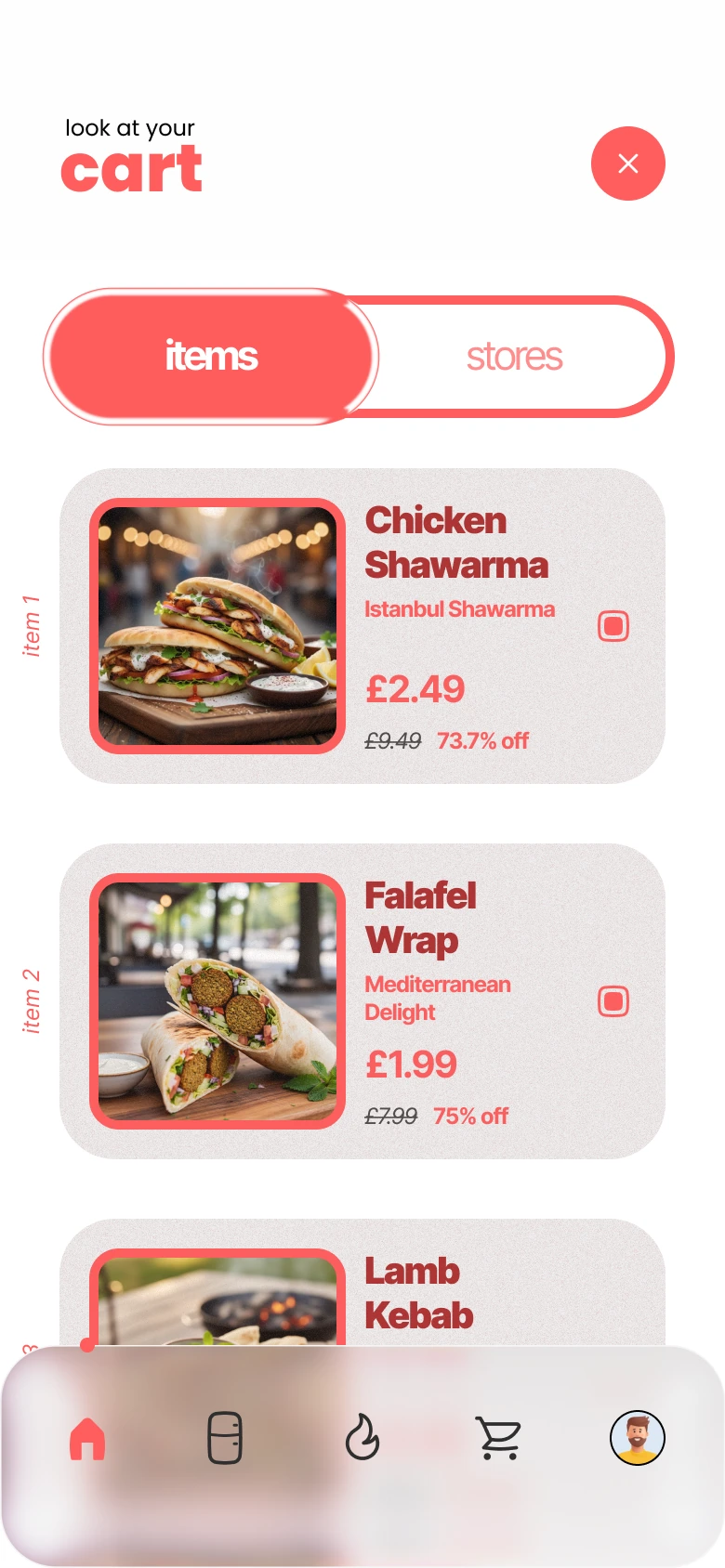
EatQuik UI design · concept prototypeMeal discovery from the EatQuik Figma prototype. Shown values are prototype samples; not a launched app.Open full-size screen: meal discovery
Project
EatQuik
Type
Independent product concept
Design focus
Marketplace UX, discovery & service flows
Status
Concept exploration · Not launched
A good match means nothing if collection fails.
Finding a promising offer is only the start. People need enough information to decide, while food partners need a manageable way to publish surplus and coordinate collection. EatQuik examines both sides of that experience.
01 / The opportunityDesign hypothesis · Not a validated finding
Less waste. Less uncertainty.
EatQuik begins with a product hypothesis: food businesses may have surplus worth offering, while nearby people may be willing to collect it when the price, timing and expectations are clear. The design challenge is not merely to show discounted food. It is to make an uncertain, time-sensitive exchange understandable and manageable for both sides.
Concept question
How might we make discovering and collecting surplus food feel simple, worthwhile and dependable?
An independently framed design question; not a quote from user interviews.
Product direction
Explore a multi-sided marketplace where people discover surplus offers and participating food providers can prepare collection-ready listings.
Proposed functionality. No partner onboarding, live transactions or operational deployment are claimed.
02 / Research groundworkPrepared instruments · Working documents
Research questions before product answers.
The EatQuik working materials include separate questionnaires for consumers and food businesses, a competitor-comparison exercise, and mapped journeys for shoppers, vendors and collection logistics. These are concrete research and design artefacts. A questionnaire document, however, is not proof that a particular number of people were surveyed or that a hypothesis was validated.
01 / Consumer questionnaire
Trust and behaviour
Questions examine food-shopping habits, interest in discounted surplus, best-before information, perceived food safety, preferred collection methods and what people want to know before purchasing.
Shopping habits
Interest in surplus
Best-before information
Perceived food safety
Collection methods
Pre-purchase information
Instrument designed · Fieldwork not verified
02 / Business questionnaire
Operational reality
Questions explore how businesses handle unsold food, inventory systems, reasons to participate, food-safety concerns, what a listing must contain and whether POS integration would help.
Unsold food
Inventory systems
Reasons to participate
Food-safety concerns
Listing contents
POS integration
Instrument designed · Fieldwork not verified
03 / Competitive review
Where the concept fits
The project proposal compares approaches to surplus discovery, sharing, redistribution and inventory management, including Too Good To Go, Olio, FoodCloud and other services. Comparisons are working analysis, not verified claims of competitors' current capabilities.
Surplus discovery
Sharing
Redistribution
Inventory management
Working analysis · Not verified competitor claims
Documented inputs
What exists
Consumer and supplier questionnaire designs, a feature-comparison matrix, proposed customer and operational flows, a business proposal, and separate app-screen and pitch-deck designs in Figma.
Evidence still to verify
What isn't established here
The appendix contains headline survey percentages, but the supplied PDF exports do not establish the respondent base, recruitment or underlying response records. Those figures are not used as validated UX findings or product impact.
Evidence reviewed from the project's consumer questionnaire, food-business questionnaire, EatQuik proposal and appendix. The underlying working files are not published here because they include material that requires privacy and evidence review.
03 / Marketplace ecosystemConceptual user needs · To be researched
One product. Different jobs to do.
A surplus-food marketplace depends on more than its customer-facing interface. Each participant has a different set of questions. These are candidate needs to investigate with real users and prospective partners; they are not presented as interview findings.
01 / Discover
Food collector
What is available nearby? What might be inside the bag? When and where would I collect it?
02 / Offer
Food partner
How much surplus can I list? How do I set a collection window and manage changes?
Service → collectorOffers, availability, pickup instructions
Collector → serviceReservations
Partner → serviceListings and collection windows
Service → partnerReservation status
03 / Coordinate
The service
How should availability, reservation status, pickup instructions and exceptions stay understandable?
Collection handoverWhere both sides complete the exchange
Concept model of proposed information flows. Not a built system, live integration or validated service blueprint.
04 / Proposed experienceIllustrative flow · Not a tested product
From discovery to collection.
The core product idea connects four moments. Each one is a potential design surface with questions that need prototyping, usability testing and operational validation.
01 / Discover
Find relevant offers
Tonight near you
Pickup timeDistanceDietary
Suggested · Why?
Bakery bag18:00–18:30
Café bag19:30–20:00
Collector needs
Explore location, collection time and suitable food options.
Concept feature
Nearby surplus-food listings, with optional assisted matching.
Question to test
What information is essential before opening an offer?
02 / Evaluate
Understand a mystery bag
?
Mystery bag
PriceShown up front
Collect18:00–18:30
PickupBakery counter
Contents vary — exact items aren't guaranteed.
Reserve
Collector needs
Know the price, pickup window and uncertainty of contents.
Concept feature
Clear bag information and transparent expectation-setting.
Question to test
What reassurance matters without promising exact contents?
03 / Reserve
Commit with confidence
Reserved
Collect today, 18:00–18:30
Reserved
Ready for collection
Collected
View pickup details
Collector needs
Understand the next step and whether an offer is still available.
Concept feature
A proposed reservation state and clear confirmation flow.
Question to test
How should last-minute availability changes be handled?
04 / Collect
Complete the handover
Collection
Pickup point: bakery counter
Show on arrivalEQ · ••••
Confirm collection
Collector needs
Find the pickup point and know what to show on arrival.
Concept feature
Collection instructions and a proposed handover confirmation.
Question to test
What happens when a customer is late or the bag changes?
Independent concept journey created to explain the intended product logic. No live inventory, actual booking engine, payment system or fulfilment integration is shown or implied.
Screens are conceptual mockups of the mystery-bag exploration, with placeholder content — not the Figma app designs, a live product or a tested design.
05 / Collection service modelsDocumented flow proposals · Not operational
Two ways to collect. Different service demands.
The original proposal goes beyond a single mystery-bag pickup. It describes customers choosing specific surplus items and considers both direct collection from participating stores and collection at a consolidated mobile hub. The four-screen sequence above is a simplified visual concept; the two paths below reflect the fuller service-flow documentation.
Route A / Store pickup
Collect directly
Documented flow · not operational
Customer
Store
Discover offersCustomer
Select eligible itemsCustomer
Choose a collection slotCustomer
Order confirmation and proposed QR codeCustomer
Navigate to the storeCustomer
Handover at the storeStore → customer
Discover offers, select eligible items, choose a collection slot, receive an order confirmation and proposed QR code, then navigate to the store for the handover. Multi-store orders would introduce further routing questions.
Based on the store-pickup flow in the working EatQuik proposal, pages 17–18.
Route B / Mobile hub
Collect at a shared point
Documented flow · not operational
Customer
Store
Driver
Hub
Select items and a collection pointCustomer
Stores prepare ordersStore
Proposed driver route consolidates pickupsDriver
Collect at the hub with a confirmation codeHub → customer
Select items and a preferred collection point; stores prepare orders; a proposed driver route consolidates pickups; the customer collects the order at the hub using a confirmation code. Every additional handoff raises service and feasibility questions.
Based on the hub, vendor and driver flows in the working EatQuik proposal, pages 19–21.
01 / Retailer
Prepare and confirm
The proposed vendor flow covers order preparation, status updates, handoff confirmation and reconciliation of unsold items.
02 / Logistics
Coordinate custody
The proposed driver flow covers route planning, pickup confirmation, order allocation and handover at the hub.
03 / Product design
Make uncertainty visible
Both models need clear availability, collection times, accessible pickup instructions, changes to orders and safe handling responsibilities.
The proposal documents intended flows; it does not establish that a fleet, hub, vending machine, retailer integration or live delivery service was deployed.
06 / Designed app screensEatQuik UI design · Concept prototype · Not launched
From choosing a meal to collecting it.
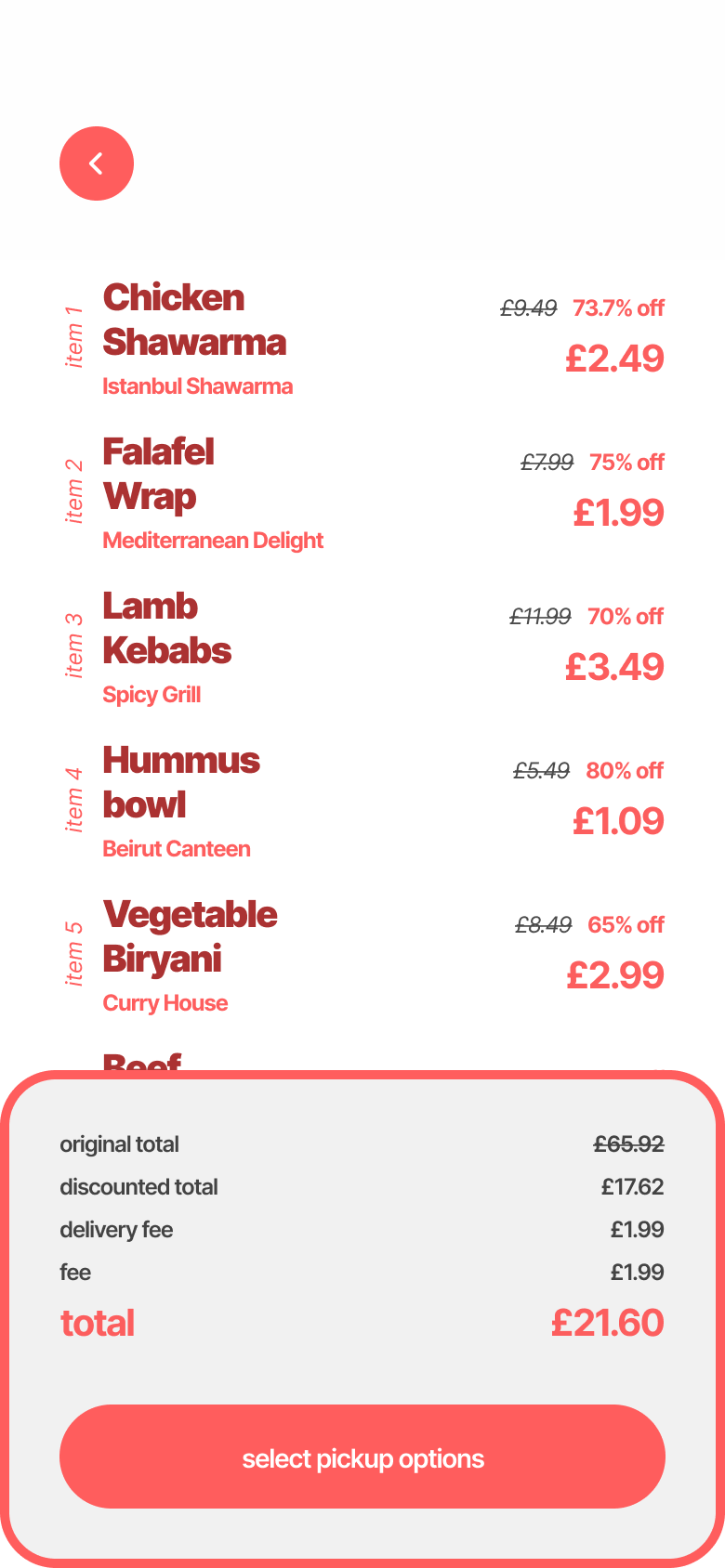
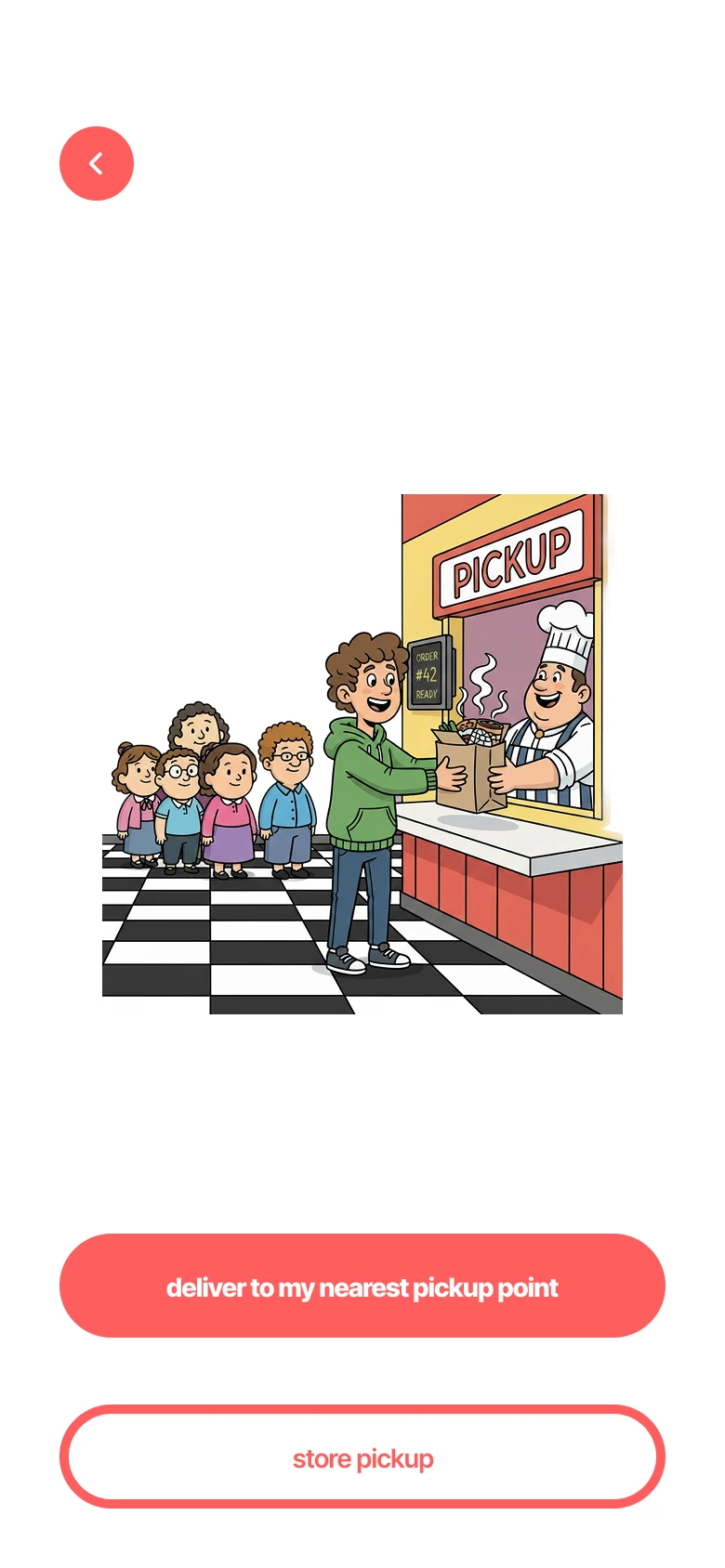
These screens come from the EatQuik Figma concept prototype. They follow the proposal's specific-item model: browsing surplus meals, reviewing a cart and order summary, then choosing between the two collection models above. They are interface designs, not a launched app.
01 / Discover
Meal discovery
Surplus meals listed with items left, search radius, nearest pickup distance and quickest delivery time.
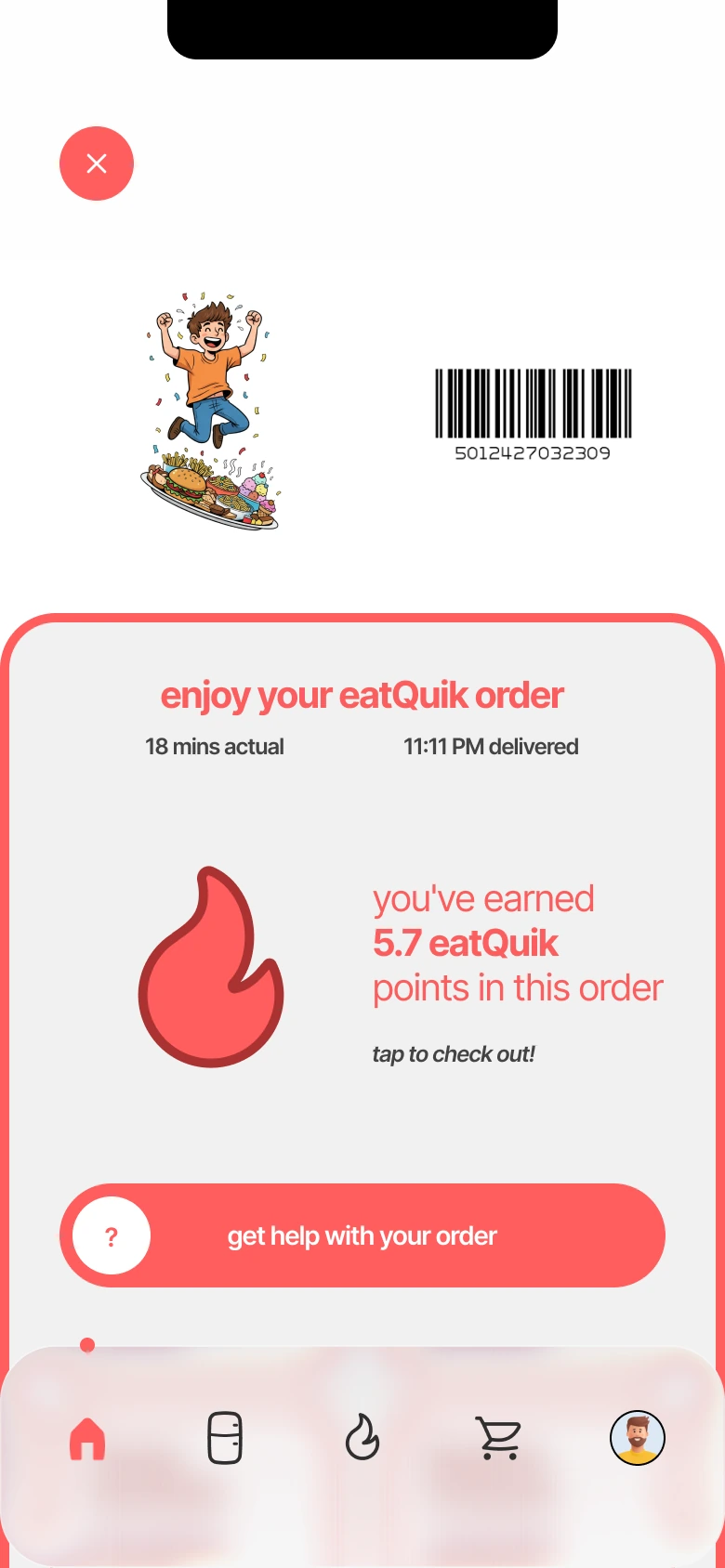
A completed-order screen design. The barcode, delivery timing and reward points shown are sample prototype values — not a real transaction, an operational result or implemented functionality.
Exported from the EatQuik Figma concept prototype. Prices, distances, times and points are prototype values, not live data, and no partnership with any business is implied. No ordering, payment, delivery or rewards functionality is implemented, and no usability-testing results are claimed.
07 / AI & trustProduct principles · No AI model deployed
Useful suggestions. Human decisions.
AI-assisted discovery is part of the EatQuik concept, not an implemented capability. A future matching experience could help surface offers based on expressed preferences, distance and collection windows. The proposal also considers meal suggestions, fridge-inventory features and surplus mapping as future directions. None is demonstrated as deployed AI. Matching must not silently decide what someone can eat, whether food is safe, or what a mystery bag actually contains.
Suggested for you
Mystery bag · BakeryCollect 18:00–18:30
Why you're seeing this
Within the distance you set
Fits your collection time
Matches preferences you saved
Suggestions never confirm allergens or bag contents.
Edit preferencesBrowse all offers
Conceptual mockup · no AI model deployed
May consider
Expressed preferences
Distance
Collection windows
Suggests
Offers worth a look, with the reasons shown
The person decides
Reserve, browse manually or change preferences
Never decides silently
What someone can eat
Whether a product is safe
What a mystery bag contains
01 / Explain
Show why an offer appears
Let people understand the factors behind a suggested match and change preferences when needed.
02 / Control
Keep manual discovery
Make browsing and filtering possible without relying on recommendations or opaque personalisation.
03 / Protect
Don't guess about safety
Ingredient, allergen and food-handling information needs a trustworthy source; AI-generated assumptions are not a substitute.
These are proposed human-centred design safeguards. They have not been validated with users or implemented in software.
08 / Design directionsIdeas under exploration
A marketplace that works on both sides.
The proposal explores choosing specific surplus items, while the current conceptual mockups also investigate mystery-bag discovery. Neither mode can stand alone: partner-side listing and collection logistics determine whether the collector experience is realistic. Vending-machine pickup is a further exploration, not a confirmed capability or part of a launched service.
Collector side · Anatomy of a mystery bag
Clear before reserving
Price
Collection window
Availability
Pickup point
Left as a surprise
Exact contents
Open question: what reassurance matters without promising exact contents?Partner side · Publishing a listing
New surplus listing
Bags to offer–2+
Collection window18:00 – 18:30
Pickup instructions
Publish listing
Conceptual mockup · placeholder content
01 / Core experience
Mystery bags
Balance a sense of discovery with clarity about price, timing, availability and uncertainty.
02 / Partner experience
Listings and collection
Explore how suppliers might publish offers and manage pickup without making extra work unmanageable.
03 / Future exploration
Alternative pickup
Investigate whether vending-machine collection could ever be operationally appropriate, rather than assuming it is.
09 / What needs validatingProposed next steps · Not completed tests
Make the hypotheses earn their place.
Before EatQuik could be presented as a viable product, the central assumptions would need evidence. The questionnaires and proposed flows establish groundwork, but they are not substitutes for transparent respondent data, usability evidence and an operational pilot. The following are further validation priorities, not completed product tests.
01 / Collectors
Test discovery and trust
Explore whether people understand mystery-bag expectations, pickup rules and AI suggestions. Test a prototype with realistic tasks.
02 / Partners
Test listing feasibility
Investigate operational constraints with prospective providers: surplus variability, staff effort, availability and collection windows.
03 / Service
Test the handover
Examine late arrivals, changes to reservations, collection confirmation, accessibility and food-information responsibilities.
Possible future measures
What would matter
Task comprehension, reservation completion, successful collection and partner effort could be examined during future tests. No figures or improvements are claimed.
Evidence boundary
What isn't demonstrated yet
No live product, production AI, merchant integrations, sales, user-testing results, impact metrics or confirmed waste reduction.
EatQuik is an opportunity to think beyond an attractive discovery screen. The quality of the experience depends on information accuracy, understandable uncertainty, the provider's workflow and a collection handover that both sides can complete. AI can be explored as an assistant, but the product still needs transparent choices and dependable service fundamentals.
Project disclosure
An independent concept — not a launched marketplace
This is a portfolio concept, not a launched marketplace. The project has documented questionnaires, competitor comparison work, service-flow designs, and separate Figma app/pitch materials. Selected screens from the Figma concept prototype are shown as UI designs; the other interface visuals are labelled conceptual placeholders. Proposed flows and AI safeguards are not implemented or demonstrated to work. Appendix survey summaries and financial forecasts have not been presented as independently validated UX results or actual product outcomes. No personal, investor or private respondent information is reproduced.