See the rep
Scrub between labelled phases and explore how the joint changes position, using an independently drawn, simplified model.
A proposed interactive learning product that makes strength training easier to understand. Explore how a rep moves, which muscles are involved, and how the phosphocreatine energy system relates to repeated high-intensity exercise — with a prominent, evidence-led Creatine Lens.
Runs in your browser · simplified educational models · lesson choices aren't saved or sent
This is a new, owner-directed portfolio concept. It is not a published scientific study, a launched product, or an existing functional training app. No participants have been recruited or usability outcomes measured for it.
Fitness information often separates movement instructions, anatomy diagrams and supplement explanations into different places. This concept explores whether bringing those layers together can help a beginner form a clearer mental model of what happens during resistance exercise.
Help people understand the mechanics and energy demands of a strength-training rep without overwhelming them with technical language or misleading certainty?
Design question created for this portfolio project; it is not a direct participant quotation.One exercise, three related ways of learning: movement, muscles and creatine/energy science.
A product proposition to test with users, not an established learning outcome.
Scrub between labelled phases and explore how the joint changes position, using an independently drawn, simplified model.
Highlight relevant muscle groups with text explanations, not invented percentages of “muscle activation”.
Use the Creatine Lens to connect phosphocreatine and ATP regeneration to repeated intense efforts, with accessible evidence notes.
How it is often learned · in separate places
Anatomy of a Rep · one exercise, three layers
Evidence cards and a short knowledge check sit alongside every layer.
The proposed first-time visitor is someone who trains or is curious about resistance exercise but is unsure how to interpret anatomy and supplement claims. This is an illustrative target scenario, not a persona inferred from interviews.
Begin with one thoroughly explained example, the dumbbell biceps curl. Other exercises can be added once their movements and evidence have been checked.
Use a keyboard-operable slider or step controls to move from start to lifting, top and lowering phases. Every visual state has readable accompanying text.
Discover ATP and the phosphocreatine system using an illustrative educational sequence, separate from the physical movement diagram.
Explore what is well supported, what depends on context and what the product cannot say about an individual body.
Try a short knowledge check with helpful feedback; the proposed demo should not collect identifying details or fabricate participant scores.
Journey map · learner questions, screens and safeguards
The first detailed lesson will explore a conventional dumbbell curl. During the lifting phase the elbow flexes; during controlled lowering it extends while the elbow flexors can act eccentrically. Relevant elbow flexors include the biceps brachii, brachialis and brachioradialis. Actual muscle contributions depend on grip, technique and context.
An illustrative starting position, with a caption showing elbow position rather than a universal prescribed lifting technique.
A simple animation demonstrates the upward phase. Explain concentric muscle action without asserting that every person's activation is identical.
The lowering phase demonstrates eccentric action of the elbow flexors under resistance. It is an educational depiction, not a real-time biomechanical measurement.
The rep, as drawn in the prototype
The elbow flexors in this lesson
Numbers match the Muscle Explorer. Shapes are simplified general anatomy and show no activation, EMG or force values; contributions vary with grip, technique and the person.
Research context: Biceps Brachii and Brachioradialis Excitation in Biceps Curl Exercise (2023). Exercise-specific content must be reviewed before adding new diagrams; no invented joint-angle precision, EMG scores or “perfect form” diagnosis.
ATP powers cellular work, including muscular contraction. Phosphocreatine helps rapidly regenerate ATP during intense efforts. Creatine supplementation can increase muscle creatine and phosphocreatine availability, supporting repeated short-duration, high-intensity exercise and training adaptations in some contexts. Several energy systems contribute to exercise; the phosphocreatine system is not the only source of ATP.
ATP used for muscular work → ADP + energy. Phosphocreatine helps replenish ATP from ADP.
An intentionally simplified teaching model; not an exact calculation, personal energy readout, or simulation of ATP concentration in a body.A single visible rep illustrates movement. The creatine explanation concerns cellular energy regeneration and repeated high-intensity efforts, not a visible glow or instant strength boost in the specific muscle being shown.
Do not animate “muscle creatine stores” as if their real-time values were observed or quantified.
Use an accessible animated pathway with pause controls and equivalent text to introduce the phosphagen system.
Explain that creatine monohydrate is the most extensively studied supplement form in this context; avoid turning the lesson into a product advertisement.
Separate evidence on repeated high-intensity exercise and resistance training from unsupported promises about any one person's results, recovery, appearance or performance.
Built in the prototype · Creatine Lens
A switch reveals a separate, five-step teaching diagram. It explains chemistry the arm drawing can't show, and never pretends to measure it.
Evidence: NIH Office of Dietary Supplements: Exercise and Athletic Performance; International Society of Sports Nutrition position stand on creatine. Scientific information is general education, not personal supplementation, medical or training advice.
The evidence layer will not just state facts; it will teach visitors to notice the difference between a physiological mechanism, a finding from published research, an application that depends on context, and a claim we cannot make.
There is substantial evidence that creatine monohydrate can improve capacity during repeated short, high-intensity exercise and support training adaptations, especially alongside resistance training.
Source: NIH ODS; ISSN position stand.
Training status, activity demands, dietary intake, study population and other factors affect whether benefits are relevant or measurable. Do not promise every person a specific gain.
Source: NIH ODS, including evidence limitations and variable study populations.
This product has no sensor for ATP, phosphocreatine or muscle recruitment. A colourful bar must not imply those measurements exist or that creatine is working in real time.
This is a product-design boundary, not a measured scientific finding.
The concept's source panel should identify the publication and explain whether a statement concerns mechanisms, exercise outcomes or a hypothetical learning illustration. It should never generate personalised dosing, medical recommendations or purchases.
| Type of statement | Example from this lesson | How the prototype shows it |
|---|---|---|
| Mechanism | Phosphocreatine helps regenerate ATP during intense effort. | Creatine Lens steps 1–3, tagged “Mechanism” |
| Research finding | Creatine monohydrate can improve capacity in repeated short, high-intensity exercise. | Evidence card with NIH and ISSN sources |
| Depends on context | Whether a benefit is relevant or measurable for one person. | “Depends on context” evidence card |
| Not claimable here | Your ATP level, your creatine stores or your personal response. | “Product boundary” card and Creatine Lens step 5 |
A clean arm-and-elbow illustration with a rep-phase scrubber and captions. The movement and joint are the focus.
Switch on muscle highlighting and read short explanations, with accessible alternative labels and muscle names.
Reveal a separate ATP–phosphocreatine learning sequence with evidence cards and misconceptions explained.
Choose curl → change rep phase → inspect muscles → activate Creatine Lens → inspect the evidence → answer one check-for-understanding question.
Planned user flow, not an observed task completion.Use progressive disclosure. Do not force first-time learners to read every scientific paragraph before they can explore a movement.
A working design hypothesis to evaluate, not a proven improvement.
Information architecture of the built prototype
The concept demo is a real local browser interaction built in semantic HTML, CSS, SVG and vanilla JavaScript. It does not simulate scientific precision it cannot deliver. Every control that appears actionable works, and the original diagrams were created for this project rather than copied from textbooks or third-party fitness platforms.
2026 · Interactive learning prototype
Six screens: movement, muscles, the Creatine Lens, evidence and a short knowledge check. Every control works, and your choices aren't saved or sent.
Really works in the browser
Illustrative, not measured
A keyboard-accessible slider and four step buttons update the arm illustration and explanatory caption in sync. Include reset and a reduced-motion path.
Selectable, named muscle areas explain biceps brachii, brachialis and brachioradialis. Selection must also work from a text list.
A prominent toggle opens the ATP/phosphocreatine explanation and simple pathway states. Include a source/details panel with no fictitious metrics.
Expand claims, reveal sources and complete a short deterministic understanding check with clear feedback; do not collect personal responses.
Squats and push-ups can be added in a later pass after exercise-specific evidence review; avoid superficial anatomy labels just to fill a catalogue.
No camera pose tracking, real-time EMG, body scanning, supplement recommendation engine, medical assessments, personalised lifting advice, external service or training-data collection.
Structure before styling: each wireframe fixes what the learner sees first and where the honesty notes sit.
Captured from the prototype itself, so what you see here is what you can click there. They follow the site's light or dark theme.
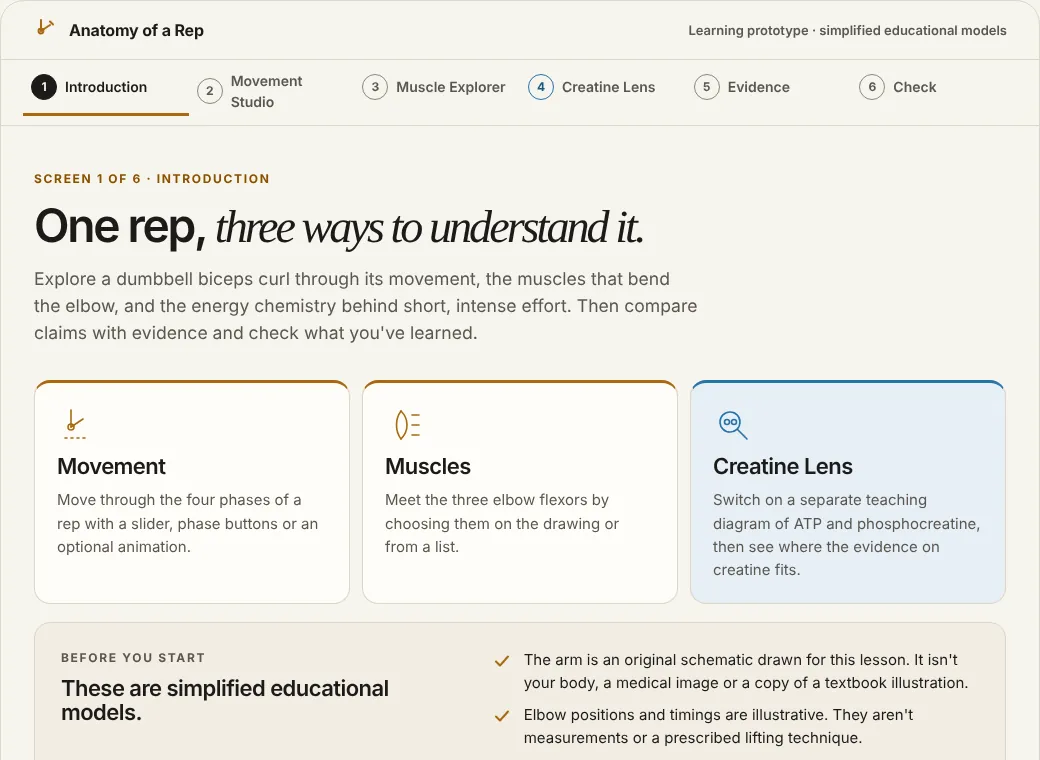
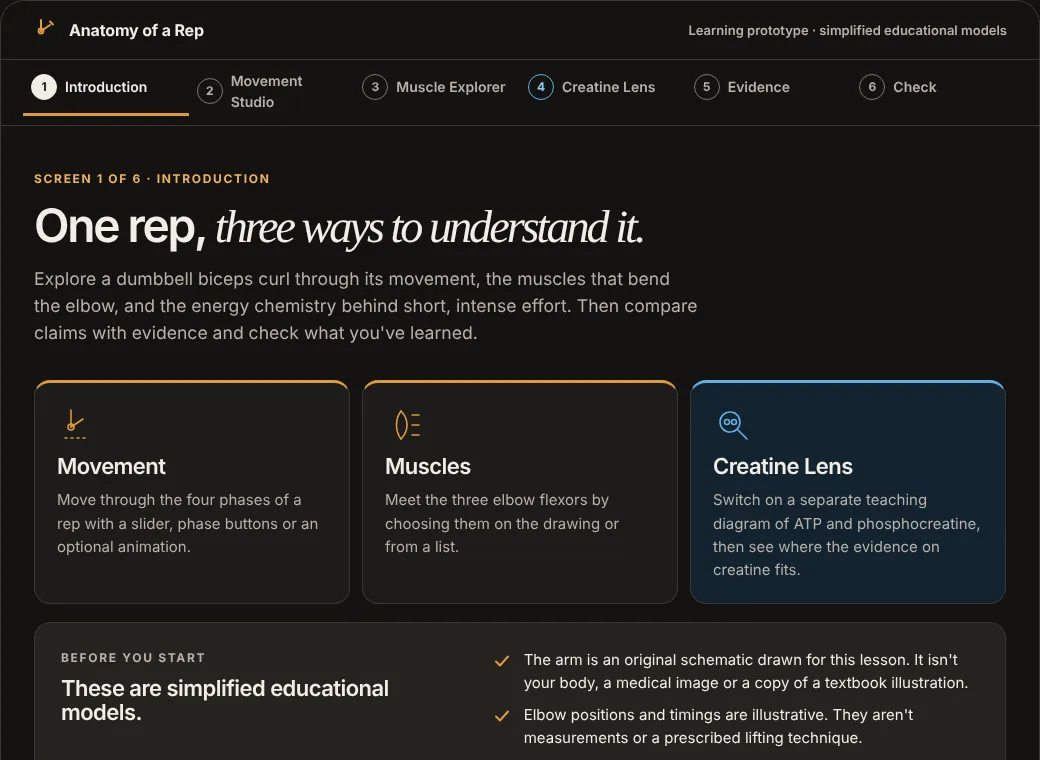
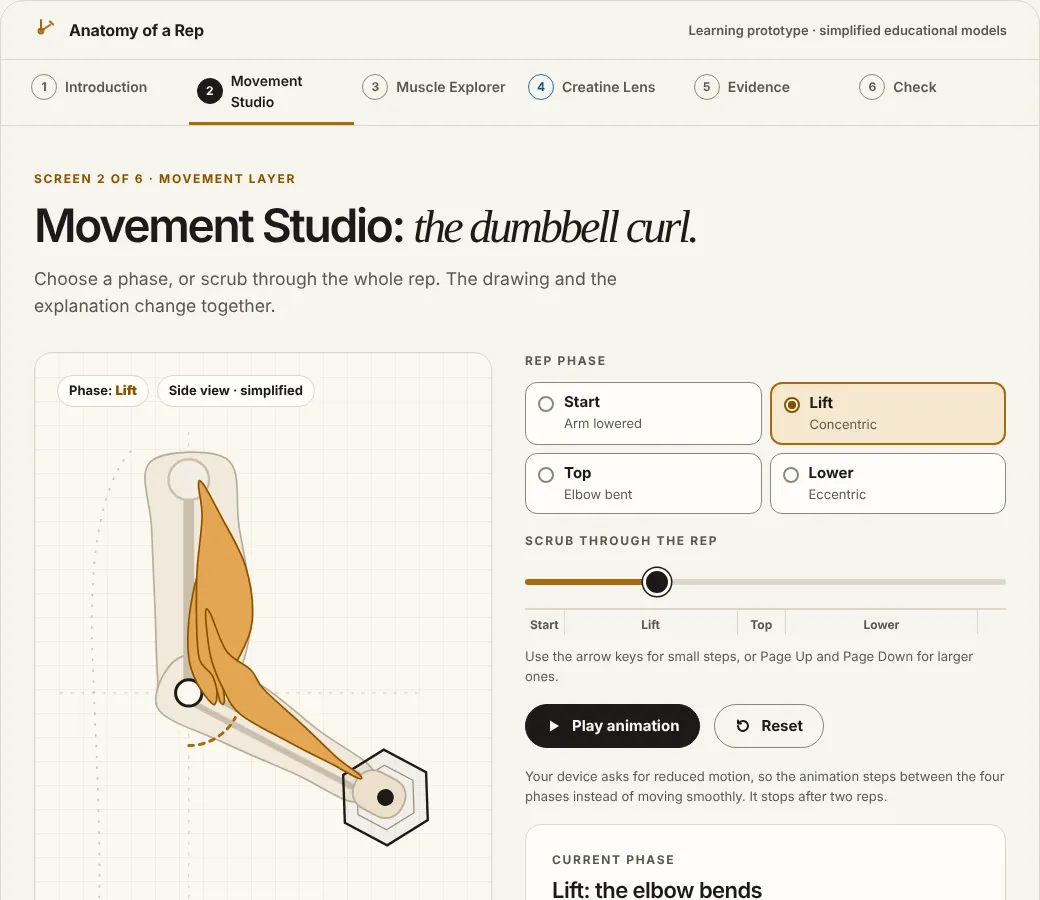
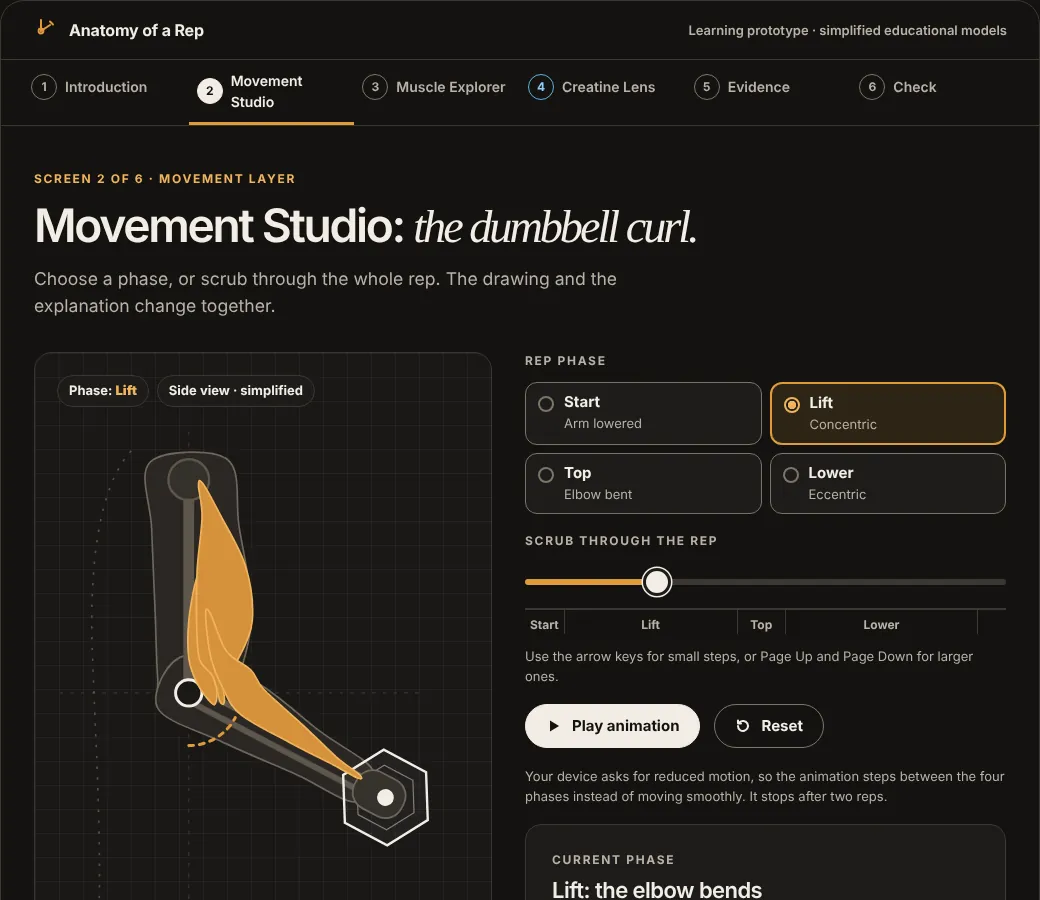
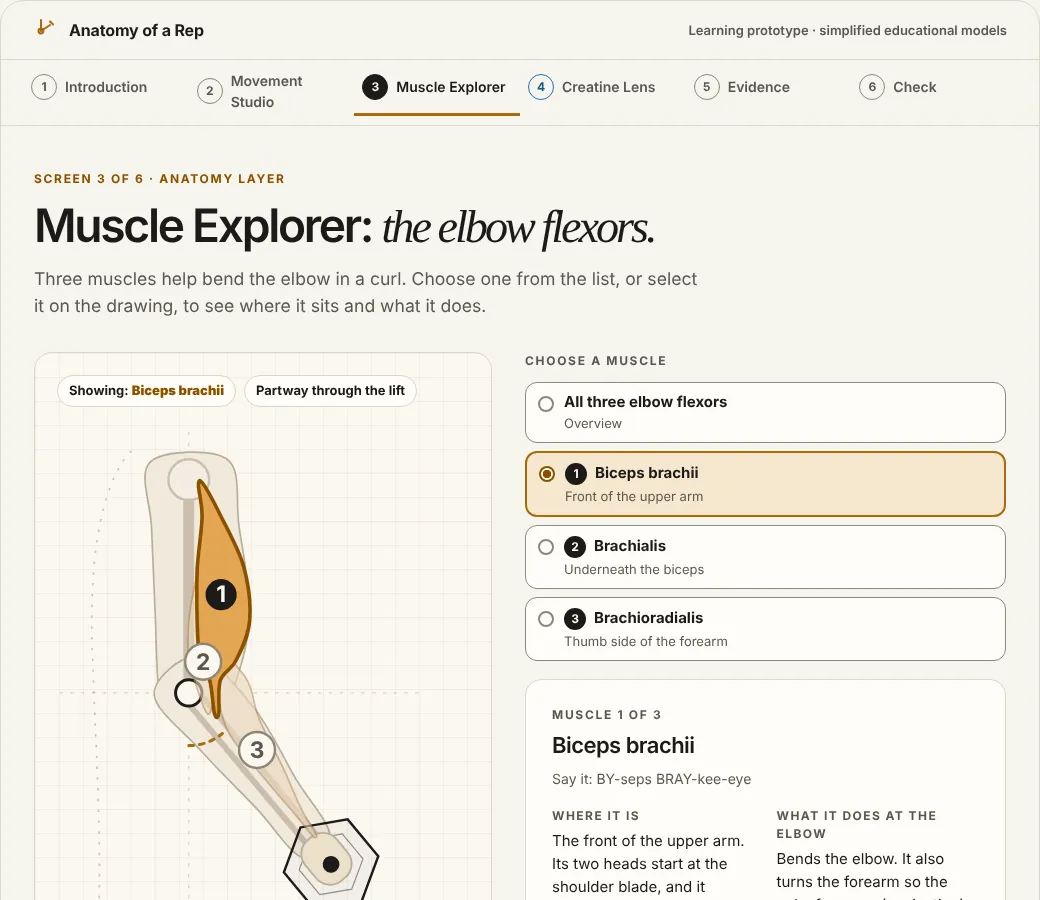
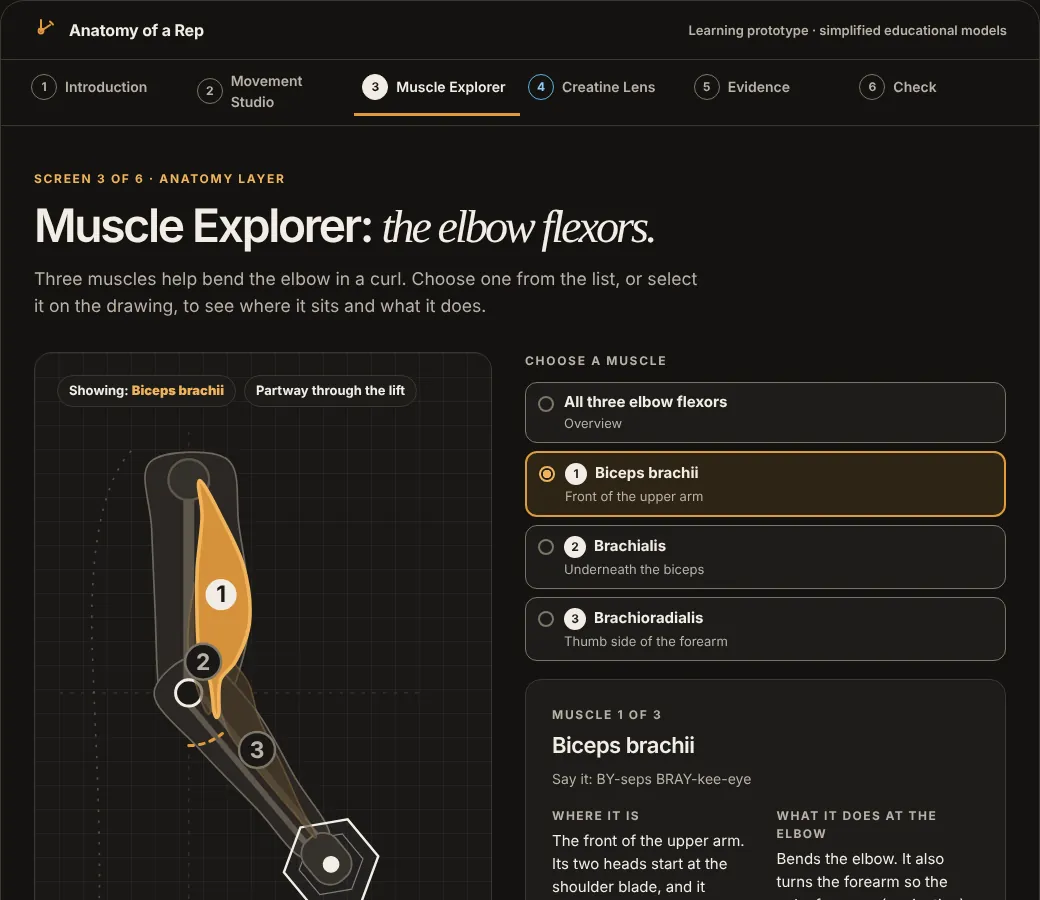
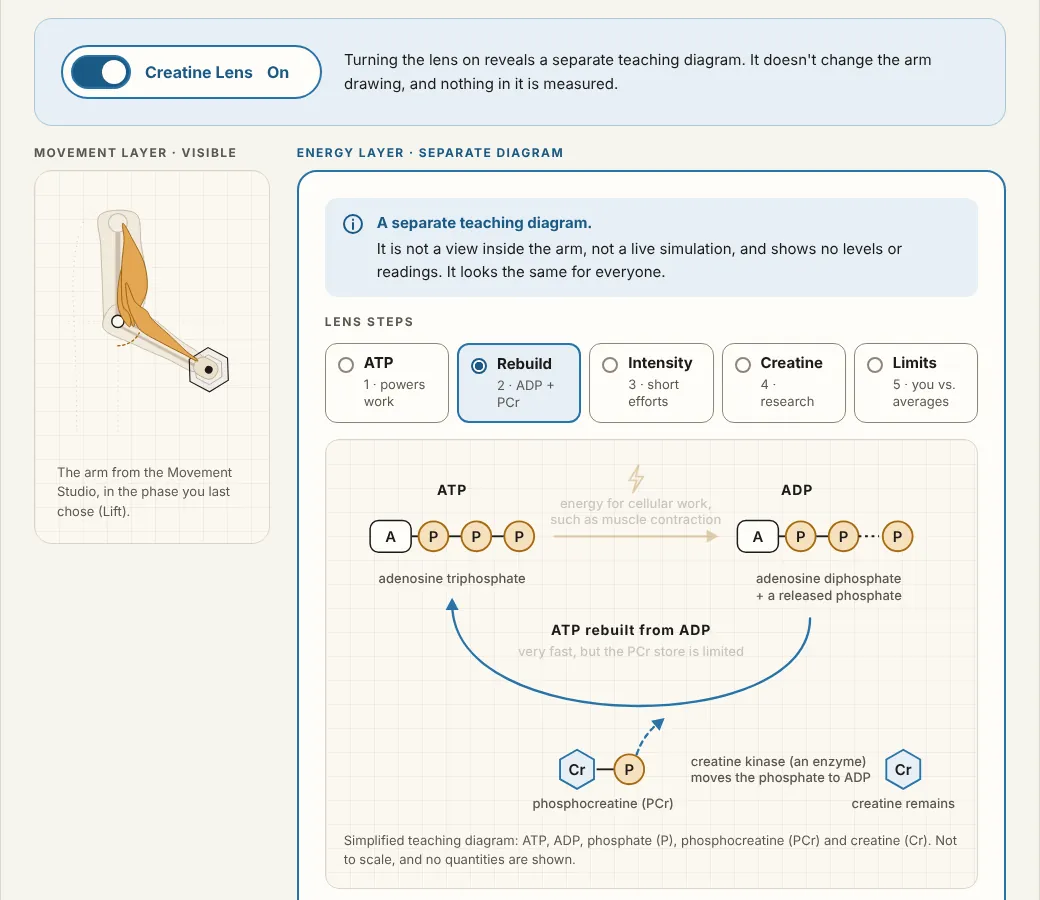
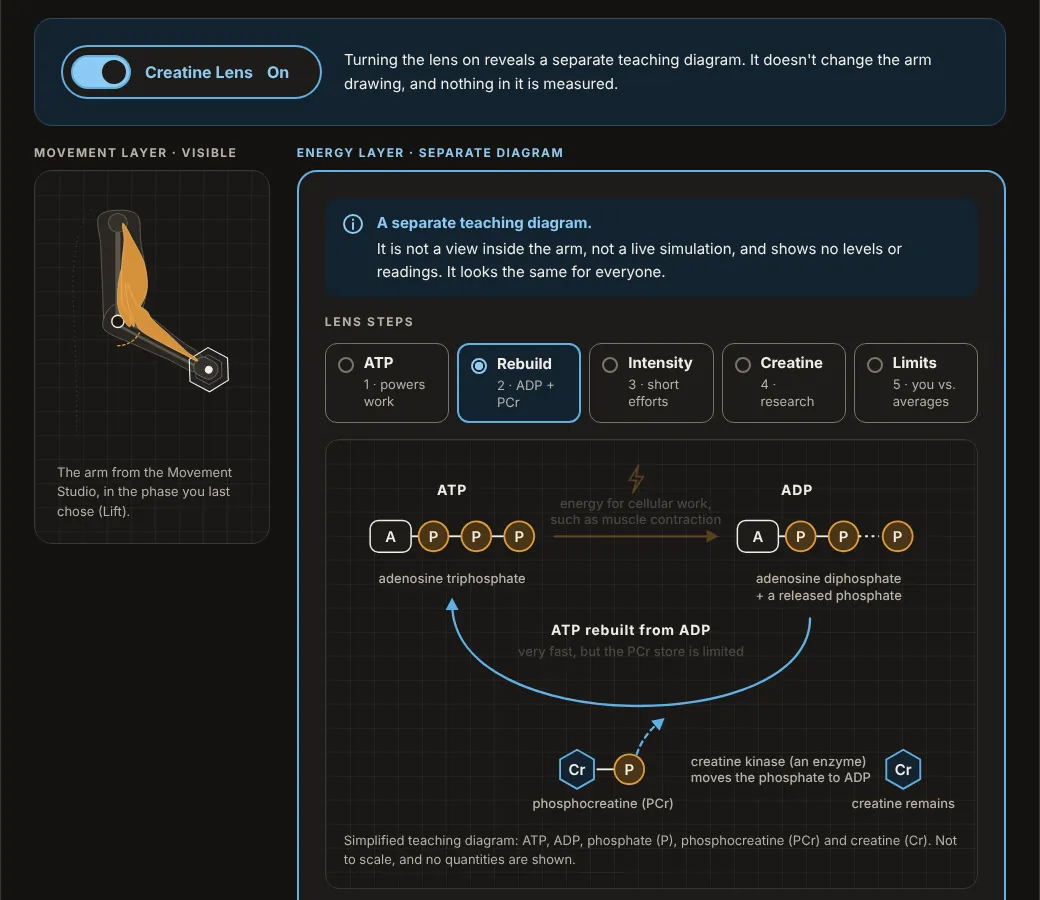


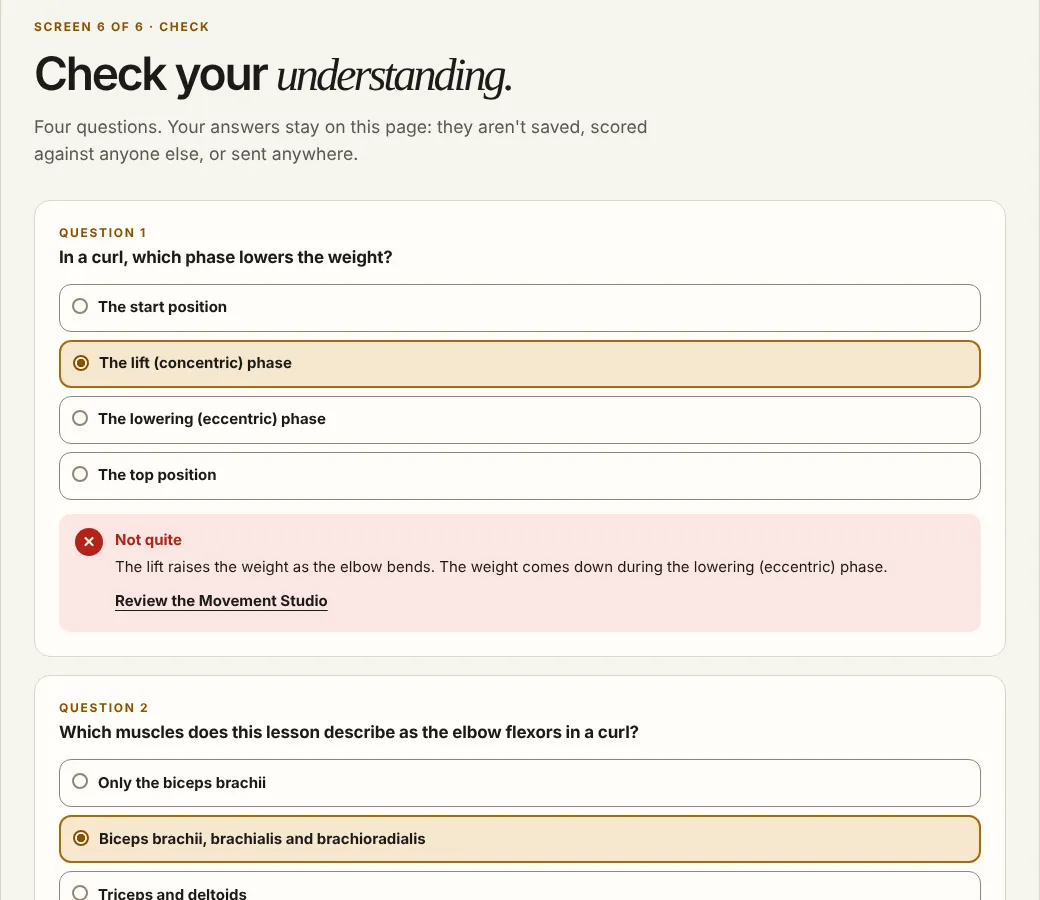
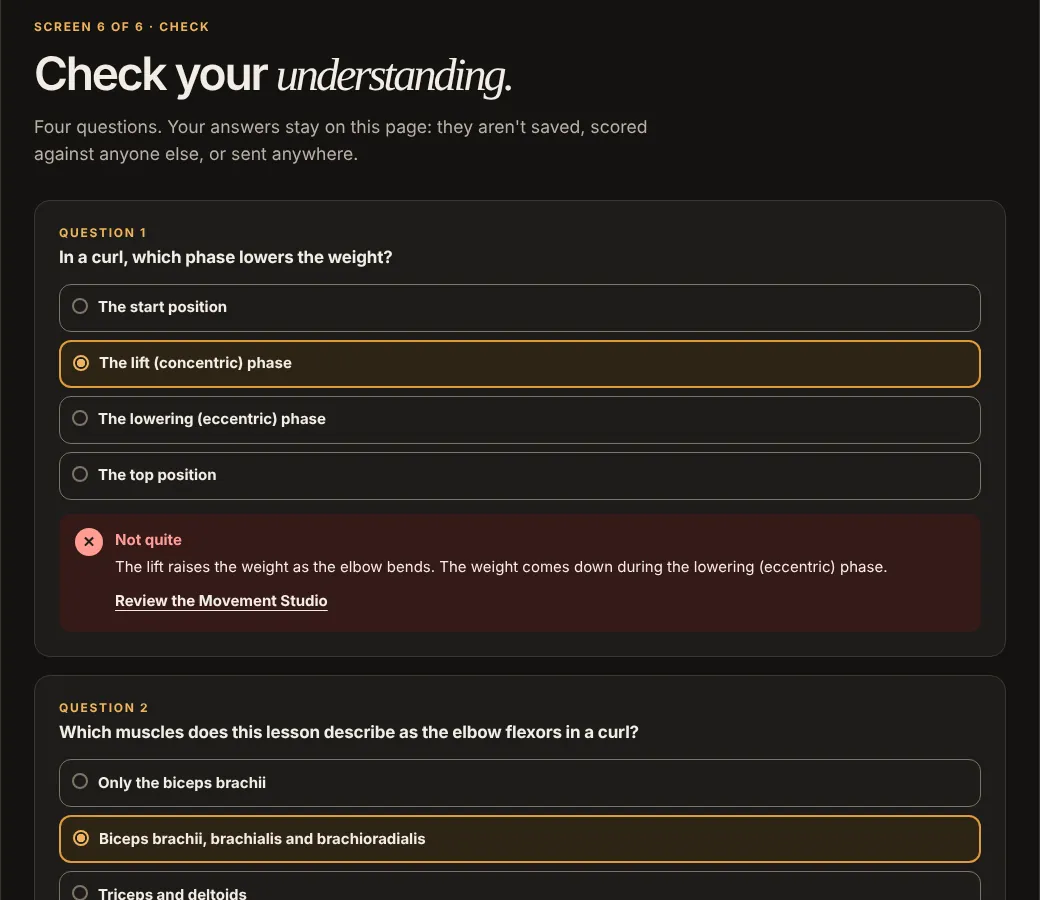
Prototype: a separate page at work/anatomy-of-a-rep-prototype.html, built with HTML, CSS, SVG and vanilla JavaScript. It was checked in the browser with automated keyboard, labelling, reduced-motion and phone-layout tests. It has not been tested with participants.
Every highlighted muscle has a readable name and description. Anatomical figures have useful alternative summaries rather than colour-only labels.
Rep phases, tab states and evidence cards work without dragging or pointer precision. Pause automatic movement and respect reduced-motion preferences.
Explain terms such as concentric, eccentric, ATP and phosphocreatine in plain language before revealing technical detail.
Use an illustrative schematic, not a “perfect” body standard. Avoid appearance-based pressure, body comparisons or personal fitness grading.
Keep supplement discussion general, sourced and qualified. Do not collect conditions, medications, body measurements or encourage dosing without individual clinical context.
Equivalent paths built into the prototype
Now that the prototype exists, a moderated or unmoderated usability study could test both interaction and understanding. No study has been run, so all tasks and measures below are proposed, not results.
Can a visitor select the eccentric phase and describe the change in elbow position using the labels?
Not yet runCan a visitor open the Lens and explain the distinction between a visible rep and the phosphocreatine system in their own words?
Not yet runCan a visitor identify why the interface does not claim to measure their ATP or predict their personal supplement response?
Not yet runCan keyboard-only users and screen-reader users explore the phases, muscle labels and source explanations?
Not yet runProposed measures: task completion, comprehension in participants' own words, error recovery and confidence before/after the lesson. No usability interviews, recruited participants, comprehension percentages or task-success metrics currently exist for Anatomy of a Rep.
Define the UX problem, first exercise, Creatine Lens, content sources, risks and accessible interaction requirements. This page documents the planned product.
Design original anatomy diagrams, progressive-disclosure screens and a functional local prototype with honest educational simulation.
Validate exercise explanations with a qualified professional, check the cited creatine science and run accessible usability/comprehension tasks.
Review evidence maintenance, privacy, rights for illustrations, accessibility, responsible health language, performance and support before any real release.
Dietary Supplements for Exercise and Athletic Performance — Health Professional Fact Sheet. General context on creatine, high-intensity performance, safety and limitations.
Safety and efficacy of creatine supplementation in exercise, sport, and medicine. Discussion of creatine and phosphocreatine mechanisms, evidence and populations.
Biceps Brachii and Brachioradialis Excitation in Biceps Curl Exercise. Scope and caveats for the exercise-specific illustration.
SP developed the UX concept, content model and illustrative interactive learning prototype in 2026. This is not recovered coursework, published clinical research, a validated training tool, a user-tested learning outcome or an existing product launch.
Publication note: scientific context and UX design interpretation are separate. Illustrative diagrams, scripted examples and hypothetical interface states are not measurements. This page provides general educational information, not medical advice, an exercise prescription, or a recommendation for anyone to take creatine.